
Supply Chain Nightmares: The Whodunnit
Winner: Deposco
Award: Best Use of AI, 2025: Gold
Brief
Background
Many growing retailers and 3PLs face critical operational challenges, including reliance on legacy systems and complex manual processes. These inefficiencies are major competitive liabilities, restricting growth and leading to serious issues such as inventory inaccuracies and order fulfillment delays. Deposco offers comprehensive supply chain execution, planning, and intelligence software solutions that resolve these core inefficiencies, providing the clarity and performance that modern supply chains demand.
Target Audience
B2B operations and supply chain leaders at growing retailers and their 3PL partners who are responsible for fixing system problems and operational inefficiencies that lead to huge revenue loss.
Objective
To creatively engage B2B decision-makers by leveraging a "Supply Chain Whodunnit" narrative. The goal is to motivate the audience to diagnose the root causes of failure (i.e., identifying the combination of Suspect, Evidence/Weapon, and Crime Scene that caused the operational issue) and position Deposco's modern SaaS solution as the indispensable technology needed to prevent future failure.
Key Message
We understand that your supply chain problems are complex and rarely caused by a single person; we provide the clarity and framework to uncover the full combination of systemic failures.
Tone and Style
Suspenseful, dramatic, and analytical. The style mimics classic detective media (case files, interrogations, crime scenes) applied to a modern business problem.
Creative Concept
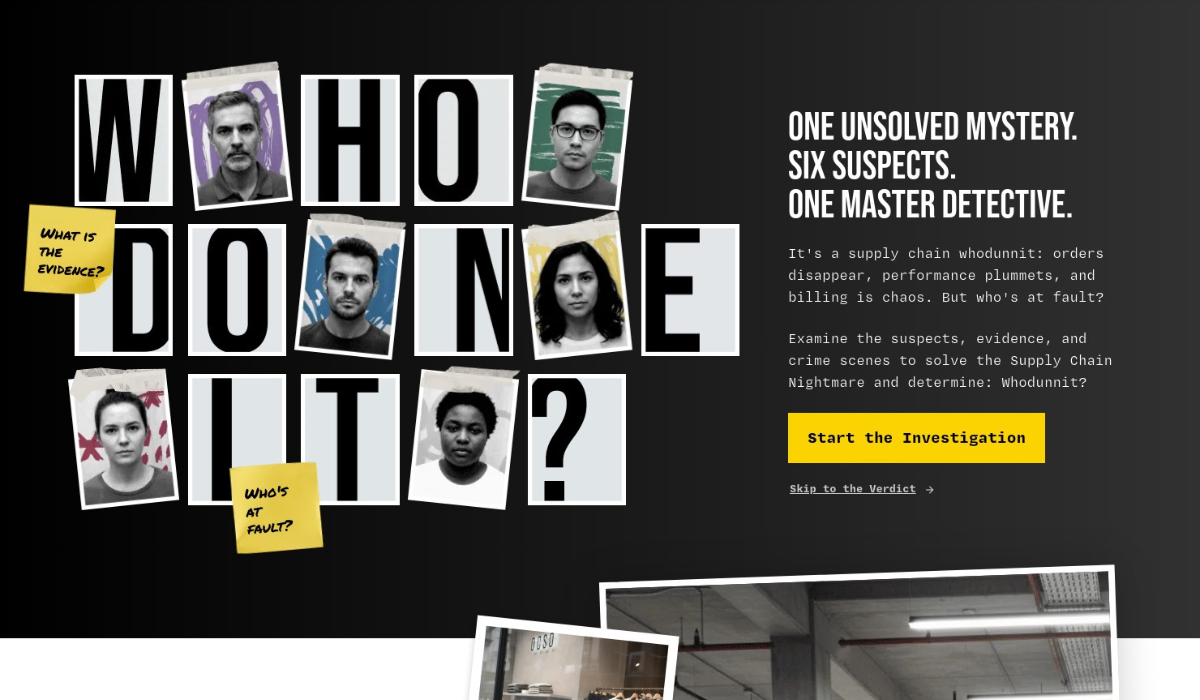
Supply Chain Whodunnit: Frame a retailer's business crisis as a crime with Six Suspects, Six Pieces of Evidence, and Six Crime Scenes. The audience acts as the "master detective" tasked with determining who (or what combination of factors) delivered the fatal blow.
Execution
The campaign is executed digitally, mapping operational failure to a detective framework: person, place, and thing. The Suspects, Evidence, and Crime Scenes are strategically selected as they represent the most common and critical areas of inefficiency that Deposco observes when engaging prospective customers. This is achieved through detailed profiles of the Suspects (user personas), close examinations of the Evidence (inefficient physical tools or outdated software), and investigation of the Crime Scenes (e.g., Packing Stations, Storage Areas) — the specific locations where daily tasks take place.
Deliverables
Interactive Microsite: The core platform hosting Suspect Profiles, Evidence Exhibits, and Crime Scenes, culminating in the user's final Verdict (primary CTA).
Video Content: A suite of videos, including a Campaign Promotional Video and Suspect Interrogation Videos (short-form character intros/testimonies).
Digital Assets: Display Ads, Social Media Creative Assets, and Email Templates for awareness and lead nurturing.
Conclusion
The campaign culminates in a final, high-stakes decision point. The "shocking truth" is revealed: There is no single culprit — everyone is guilty. The game was rigged by a fatal business mistake — fragmented fulfillment systems and processes that perpetuate the nightmares. The resolution is the Plea Bargain, where each Suspect can achieve immediate operational correction by adopting a specific Deposco Bright Suite solution, thereby transforming system-level failures into unified operational clarity.
Solution
AI-Engineered Production Pipeline for Narrative Content
This project achieved the brief—to create a complex, high-fidelity "whodunnit" campaign (people, places, and things) —by engineering a systematic node-based AI workflow that dramatically redefined content production efficiency. This solution directly addresses the award criteria for Innovation and Effectiveness. The creative brief was executed by building a reusable, algorithmic pipeline that enabled a single creator to design and execute the entire visual library. This methodology drove a measurable business impact: achieving a remarkable 96.7% reduction in time-to-asset delivery compared to traditional methods and creating bespoke, high-quality imagery essential for the campaign's success. We deserve to win because we went beyond tool adoption to engineer a production solution that maximized output while minimizing staff and time, proving AI's superior role in content scalability.
Innovation Through Chained Engineering and Realism
The project's innovation lies in its highly structured, five-stage workflow, developed once and instantly reusable for all six suspects and all related assets. This process converted what would typically be a time-consuming, multi-person effort into a predictable, automated sequence:
Chained AI Workflow: The system precisely linked tools like Midjourney (for concept generation), Nano Banana (for refinement and isolation), and Topaz Lab (for final upscaling) into a sequential, node-based process. This engineering approach guaranteed quality at every step, streamlining execution.
Realism Engineering: The Enhancor tool was strategically included as the critical quality control gate. Its function was to actively counteract the "fake" look of raw generative AI by introducing realistic texture and subtle imperfections to skin and features. This step guaranteed the photo-realism and emotional micro-consistency necessary to reinforce the campaign's serious, investigative mood.
Scope and Scaling: This efficient pipeline was applied across the entire narrative—from the creation of individual Suspects to the generation of realistic Crime Scenes and detailed Evidence. This ensured every visual element was hyper-relevant, bespoke to the "whodunnit" theme, and visually cohesive.
Effectiveness and Dynamic Content Automation
The workflow’s effectiveness was maximized by automating the most time-consuming creative steps and enabling parallel output:
LLM Prompt Engineering as a Service: A Key LLM Agent converted simple creative briefs (like "create an interrogation scene") into a structured set of prompts, eliminating manual, trial-and-error prompt writing. The LLM also encoded the core character identity into every prompt, ensuring consistent style transfer across new angles and characters.
Dynamic Asset Generation: The final, high-fidelity character asset became a highly versatile style input for generating dynamic content. The system utilized parallel nodes to rapidly produce countless multi-angle B-roll shots, contextual scenes, and sequential character profiles. This capability ensured continuous, high-quality visual content for video trailers and microsite interactions.
This engineered process yielded a profound business impact: the AI pipeline reduced a project requiring over 240 person-hours across multiple roles into one completed in under 8 hours by a single individual, proving the unmatched Scalability and Effectiveness of this systematic AI application.
Results
Why "Supply Chain Nightmares" Should Win Best Use of AI
The "Supply Chain Nightmares" project deserves to win this year because it presents a systematically engineered solution to the content scalability crisis, moving beyond simple AI adoption to create an industrialized, single-creator production pipeline. The project flawlessly met the creative brief by demonstrating unparalleled Innovation, Effectiveness, and Brand Synergy while delivering sustained, measurable campaign success.
I. Innovation: Engineering the Production Pipeline
Our submission sets a new standard for content creation through the engineering of a Node-Based AI Workflow—a central hub that orchestrates the entire process. This revolutionary methodology:
Chained Specialized AI: We innovated by chaining multiple specialized models (e.g., Midjourney, Nano Banana, Enhancor, Topaz Lab) in a mandatory sequence. This guaranteed fidelity, converting a low-quality generative process into a high-quality finished product.
Realism Engineering: The strategic inclusion of the Enhancor tool specifically to counteract the "fake" look of raw AI output (perfect skin, glossy hair) guaranteed photo-realism. This step was essential for the serious, investigative tone, reinforcing Brand Synergy.
LLM Templating: We used LLM-driven Prompt Engineering to automate the creation of over 50 B-roll and profile shots. A single reference image dictated style, allowing the system to instantly generate complex multi-angle scenes and a full roster of diverse characters.
II. Effectiveness: Scalability and Measurable Impact
The AI pipeline delivered a measurable impact, transforming a high-demand creative challenge into an efficient production run:
Time and Staff Efficiency: The workflow resulted in a 96.7% reduction in time-to-asset delivery. This means a project that would have required over 240 person-hours across multiple roles was completed in less than 8 hours by a single creator. This validates the efficiency of the AI solution in maximizing output while minimizing resources.
III. Campaign Performance: Sustained Authority and Engagement
The AI-driven realism and immersive content structure translated directly into superior engagement and market authority, validating the strategic relevance of the B2B detective narrative:
Record Engagement: The campaign achieved exceptional engagement, capturing 57% of Deposco's entire active user base upon launch and driving over 56% of all recorded user sessions. It achieved a 17.22% Engagement Rate, proving the immersive quality of the AI-generated visual assets.
Market Authority: The campaign's sustained relevance (now in its 4th successful year) was validated by consistent Earned Media Coverage across popular news outlets including Yahoo Finance, CBS 42, and GlobeNewswire.
Conclusion
"Supply Chain Nightmares" should win because it is not merely an example of AI use—it is an engineering blueprint for the future of content marketing. The project successfully tackled the industry's need for speed and personalization at scale by delivering a 96.7% efficiency gain, all while elevating visual quality beyond the status quo. This submission demonstrates a critical advancement in content production methodology.